This weeks Literary Ledger 6 to 13 March 2026
Welcome to your weekly roundup of all things books! We’re keeping it short and sweet, just five stories to keep you in the loop without overwhelming you. Think of this as your quick fix for staying connected to the book world.
I) Grammarly Faces Lawsuit Over AI “Expert Review” Feature
I think we’re all very familiar with Grammarly. It’s what people used before AI really took off. You could use the normal version (free), which fixed basic grammar, punctuation, spelling, and sentence structure, or the premium version, which offered more advanced writing support, things like full-sentence rewrites, tone adjustments, vocabulary enhancements, and plagiarism detection.
I’m sure that before the likes of ChatGPT, Gemini, Grok, and DeepSeek (and many more as time goes on), Grammarly was doing very well. It was that extra step students or professionals could take to guarantee, or at least reassure themselves, that their work was up to standard. It also cut back on the time it took to edit your writing, especially if writing didn’t come naturally to you.
However, since the rise of AI, I can imagine business is not what it used to be, nor what it ever will be again.
The reason we’re talking about it now is because Grammarly is facing a lawsuit over an AI feature called “Expert Review”. The tool generated writing advice while presenting it as coming from well-known authors, journalists, and academics, but without their permission.
This is exactly why many creatives are concerned and frustrated about the development of AI in their field. Not only does it involve the use of content and material they worked hard to produce, but that very same material can then be used to train AI systems that might later be positioned as replacements for the people who created it in the first place.
The Expert Review feature allowed users to upload their writing and receive editing suggestions supposedly “inspired by” famous experts. The feedback was presented in a way that made it seem as though it came from real writers. But in reality, the comments were generated entirely by AI, not by the people whose names were attached to them.
Journalist Julia Angwin filed the lawsuit on behalf of others whose identities were allegedly used in the tool.
II) Nibbies Indie Bookshop Finalists
Two big things we’re going to touch on this week are, of course, the continuation of the The British Book Awards 2026 (aka the Nibbies) and the London Book Fair, which I’ll mention later.
First, the Independent Bookshop of the Year winners have been revealed. Nine independent bookshops across the UK and Ireland have been named regional and country winners. However, it’s not over yet. These shops will now move forward to compete for the overall Independent Bookshop of the Year title, which will be announced at the awards ceremony in May as part of The British Book Awards 2026.
The nine regional and country winners are:
Backstory – London winner
Book Lovers Bookshop – Scotland winnerGriffin Books – Wales winner
The Secret Bookshop – Island of Ireland winner
The Book Hive – East England winner
Five Leaves Bookshop – Midlands winner
Forum Books – North England winner
Hart's Books – South-East England winner
FOLDE Dorset – South-West England winner
III) Authors Protest AI at the London Book Fair
The London Book Fair had a lot going on this year, and I’m sure there’s plenty to report on. As I was also volunteering there, it was even nicer to see everything, and take part in it, in person.
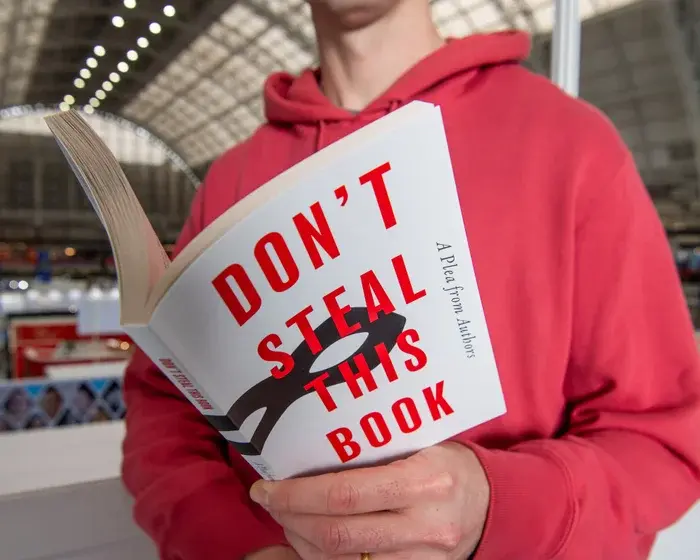
One of the most striking things I saw while I was there, which has since been widely reported on, involved a book called Don't Steal This Book. More than 10,000 authors have published an “empty” book, where the only content is a list of their names, as a protest against AI firms using their work without permission.
Copies of the book were handed out to attendees at the London Book Fair on Tuesday, just a week before the UK government is expected to release an assessment on the economic impact of proposed changes to copyright law. Unfortunately, even though I was there, I didn’t manage to snag a copy, but oh well, the message is more important.
The protest comes in response to a government proposal that would allow AI companies to use copyright-protected work without the owner’s permission, unless the creator specifically opts out. Many British artists and writers have responded strongly to the idea, arguing that it places the burden on creators to protect their work rather than on companies to seek permission in the first place.
IV) Greg Greeley Takes the Helm at Simon & Schuster
Greg Greeley is the new CEO of Simon & Schuster, replacing Jonathan Karp, who had held the role for about five years. The leadership change marks a new phase for the major publishing house. Interestingly, Greeley comes from a technology and media background rather than traditional publishing, having held senior roles at Amazon, where he worked on global digital businesses and subscription services.
I suppose this shift suggests that S&S may now focus more heavily on digital growth and global expansion. Karp hasn’t left the company completely, but he will now take on a more publishing role.
There are two sides to this change. On one hand, Greeley’s experience building large digital businesses could strengthen their strategy for e-books and audiobooks, provide better data on reader behaviour, and improve global digital distribution. His influence might modernise operations and help the company adapt more effectively to technology.
On the other hand, Amazon has often been criticised for pushing deep discounting that squeezes publishers and bookshops, as well as for promoting high-volume consumption and algorithm-driven sales. Some worry that an Amazon-style mindset might prioritise scale and efficiency over editorial judgement and cultural value.
So, while there’s clear potential for innovation, we’ll have to wait and see how this change balances growth with the traditional values of publishing.
V) Sarah J. Maas on Call Her Daddy: Two ACOTAR Books Coming
Technically, this belongs in last week’s blog, and I can’t believe I missed it, but I can’t ignore it! On the Call Her Daddy podcast, hosted by Alix Cooper, Sarah J. Maas, the author of the massively popular series A Court of Thorns and Roses, Throne of Glass, and Crescent City, was the guest on one of the most recent episodes.
The biggest takeaways are that Sarah revealed two back-to-back ACOTAR books are coming: the first in October and the second in January. She also spoke about her stance on the ACOTAR TV series. She has regained the rights to the show and, since getting them back, it’s clear she doesn’t want to lose them again. For now, she’s focusing on the books and wants to remain very much in control of any content that is produced.
Honestly, the podcast was a bit underwhelming. When asked questions, which weren’t particularly intense, considering it’s Call Her Daddy, she didn’t make much effort to keep details consistent, often speaking off “vibes.” Her answers felt underdeveloped and almost suggested she doesn’t fully know her own world. And after reading her books, I found her worldbuilding questionable at best. She seemed to suggest that readers pay too much attention to details because she doesn’t have clear answers, and isn’t that kind of the point of reading, to interpret and read into the story?
She appeared unprepared to talk about her own series, which surprised me. If I were the author, I would use readers’ confusion and questions to fix plot holes, but she seemed to rely on vibes and tropes rather than careful worldbuilding and character development. Her answers rambled, ended mid-sentence, and often jumped to a new thought before finishing the last, almost mirroring her writing style.
This is also a reason why she went on Call Her Daddy: Cooper isn’t known for in-depth or challenging questions. The podcast lets guests say what they want and hypes them up, even if they shouldn’t be praised so freely. It’s entertaining, but not exactly enlightening if you’re hoping for insight into the series itself.

Comments